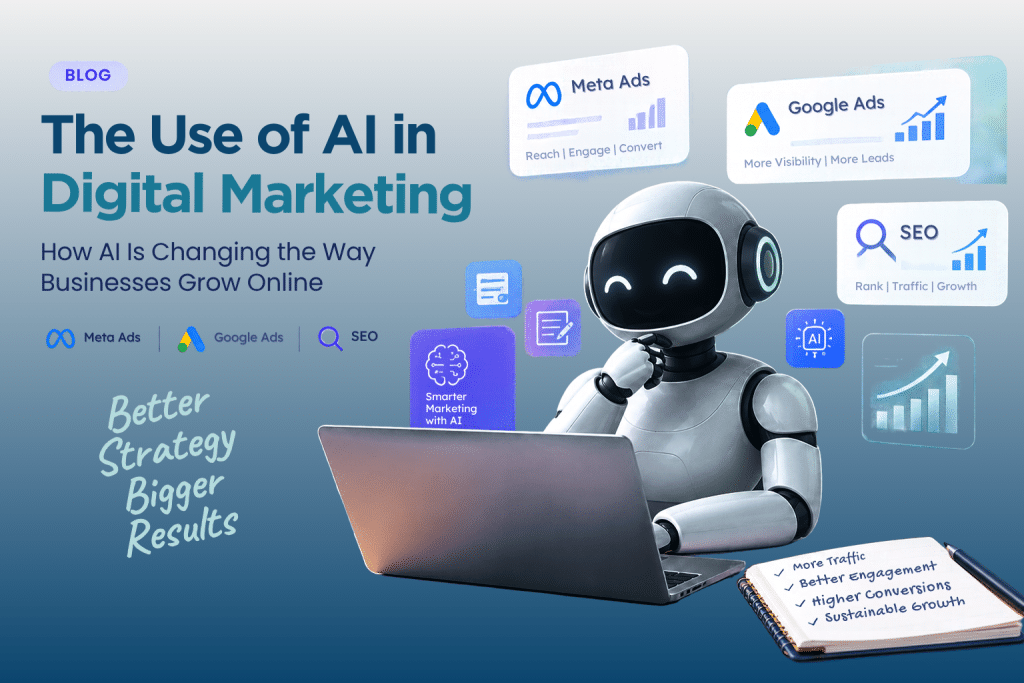
AI is no longer just a futuristic technology. It has become a practical part of modern digital marketing.
From understanding customer behavior and creating content to optimizing advertising campaigns and improving SEO, Artificial Intelligence is changing how businesses attract, engage, and convert customers online.
But AI isn’t here to replace marketers.
It is here to help marketers make faster, smarter, and more data-driven decisions.
In this article, we’ll explore how AI is being used in digital marketing, its key benefits, real-world applications, limitations, and how businesses can use it effectively.
What Is AI in Digital Marketing?
Artificial Intelligence in digital marketing refers to the use of AI-powered technologies to analyze data, identify patterns, automate tasks, generate content, predict customer behavior, and improve marketing decisions.
Traditional marketing often depends heavily on manual research and analysis.
AI can process huge amounts of information much faster, helping marketers understand:
- Who their customers are
- What customers are searching for
- Which content gets attention
- Which advertisements perform best
- What customers are likely to do next
- Which marketing channels generate better results
The biggest advantage isn’t simply automation.
It’s the ability to turn large amounts of data into useful marketing insight
Why Is AI Becoming Important in Digital Marketing?
Digital marketing generates enormous amounts of data every day.
Businesses can collect information from websites, search engines, social media, advertising platforms, CRM systems, email campaigns, and customer interactions.
The challenge isn’t always getting data.
The challenge is understanding what to do with it.
AI can help marketers identify patterns that may be difficult or time-consuming to discover manually.
For example, AI can help identify:
Which audience is most likely to convert?
Which content topics are gaining attention?
Which customers are likely to make another purchase?
Which campaign elements are underperforming?
This allows marketers to spend less time on repetitive analysis and more time on strategy, creativity, and customer experience.
Major Uses of AI in Digital Marketing
1. AI-Powered Content Creation
One of the most visible uses of AI in marketing is content creation.
AI tools can help marketers generate ideas, outlines, drafts, headlines, social media concepts, product descriptions, email variations, and other marketing assets.
For example, instead of starting with a blank page, a marketer can use AI to generate several campaign concepts and then refine the strongest idea.
AI can help with:
- Blog topic ideas
- Social media posts
- Ad copy
- Headlines
- Email drafts
- Product descriptions
- Video scripts
- Content outlines
- Content repurposing
However, there’s an important distinction:
AI-generated content isn’t automatically good content.
Effective marketing content still requires human understanding of the audience, brand voice, positioning, emotions, and business objectives.
The strongest approach is often:
AI for speed + human expertise for strategy and quality.
2. AI in Meta Ads
AI is increasingly important in social media advertising.
Platforms such as Meta use machine-learning systems to help advertisers find people who are more likely to take the desired action.
AI can support different parts of the advertising process, including audience optimization, creative variations, delivery optimization, and performance analysis.
For marketers, this means the role of the advertiser is evolving.
Instead of relying only on manual audience selection, marketers increasingly need to focus on:
- Strong creative concepts
- Clear offers
- High-quality ad copy
- Accurate conversion signals
- Testing strategies
- Campaign structure
- Landing-page experience
The key lesson:
Better inputs can help AI-powered advertising systems make better decisions.
If your offer, creative, tracking, or conversion experience is weak, simply adding AI won’t magically create a successful campaign.
3. AI in Google Ads
Google Ads is another area where AI and machine learning play an important role.
AI-powered systems can help with bidding, campaign optimization, targeting, ad variations, and identifying potential customers.
For marketers, AI can help answer questions such as:
- Which searches are generating conversions?
- Which audiences are more valuable?
- Where should budget be allocated?
- Which campaign elements need improvement?
- What patterns appear in conversion data?
This can make campaign management more efficient.
But marketers still need to provide strategic direction.
AI can optimize toward a goal—but humans need to make sure the goal itself is correct.
4. AI and SEO
SEO is also changing because of AI.
AI can help SEO professionals analyze keywords, identify content opportunities, understand search intent, analyze competitors, and improve content structure.
AI can support SEO tasks such as:
- Keyword research
- Search intent analysis
- Content briefs
- Topic clustering
- Content optimization
- Competitor analysis
- Internal linking suggestions
- Technical SEO analysis
- Content gap analysis
However, SEO isn’t simply about generating thousands of AI-written articles.
Search engines increasingly focus on whether content is useful, relevant, trustworthy, and genuinely valuable to users.
That means businesses should focus on creating content that:
Answers real questions → demonstrates expertise → provides useful information → satisfies user intent.
AI can help accelerate the process, but human expertise remains essential.
5. AI for Customer Personalization
Customers don’t want to feel like another number in a database.
They expect brands to understand their interests and needs.
AI can help businesses personalize marketing experiences based on customer behavior and available data.
For example, an ecommerce business may use customer activity to recommend products that are more relevant to an individual shopper.
Similarly, marketers can use AI to create different messages for different audience segments.
Instead of:
One message for everyone
Businesses can move toward:
More relevant messages for different customer groups.
This can improve the customer experience and make marketing communication more meaningful.
6. AI-Powered Analytics and Predictive Marketing
Marketing data tells you what happened.
AI can help marketers identify patterns and estimate what may happen next.
This is where predictive marketing becomes valuable.
AI can analyze historical and current data to identify patterns related to:
- Customer behavior
- Purchase probability
- Lead quality
- Customer churn
- Campaign performance
- Product demand
- Audience behavior
For example, instead of simply asking:
“How many leads did we generate?”
A business could ask:
“Which leads are most likely to become customers?”
That shift can help businesses focus on quality rather than just quantity.
7. AI Chatbots and Customer Support
AI-powered chatbots can help businesses respond to common customer questions quickly.
They can assist with:
- Frequently asked questions
- Product information
- Basic customer support
- Appointment-related queries
- Lead qualification
- Initial customer interactions
This can help businesses provide faster responses while reducing repetitive manual work.
However, businesses should be careful not to make every customer interaction feel robotic.
For complex, sensitive, or high-value conversations, human support can still be extremely important.